


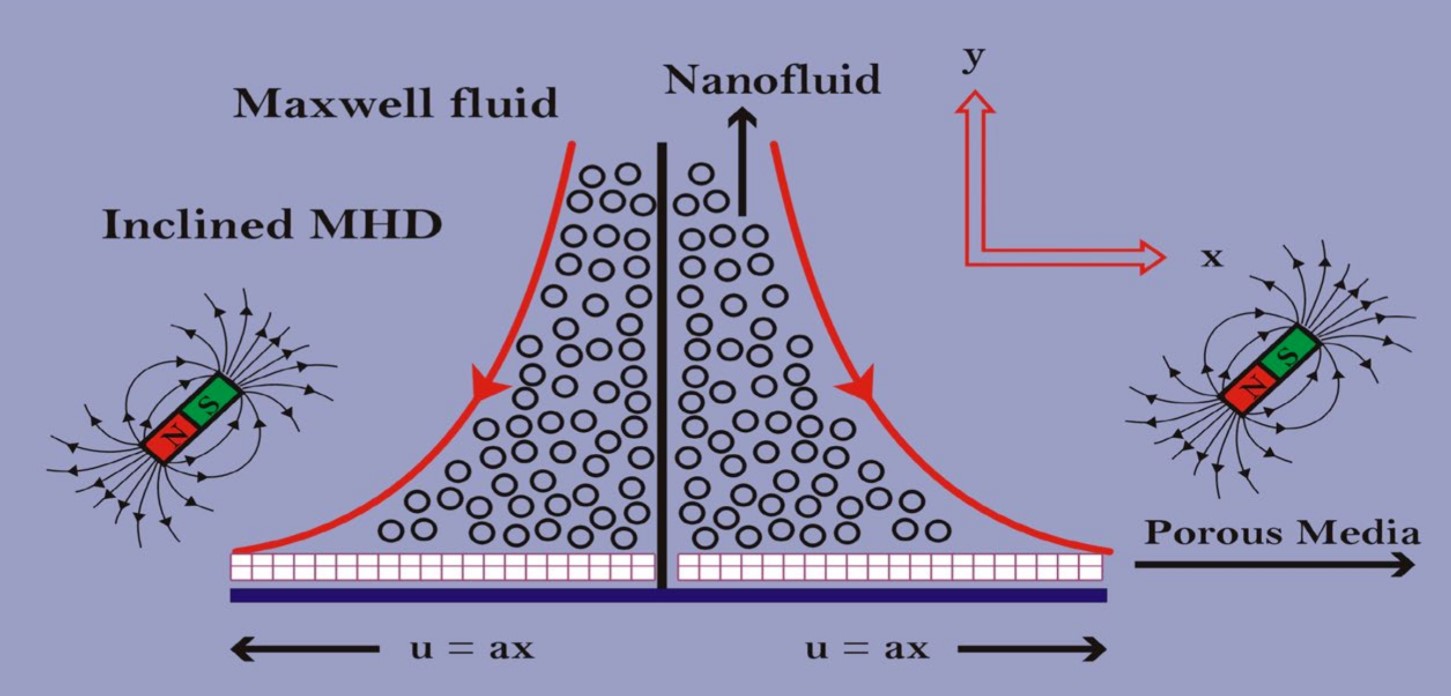
This research investigates the thermal performance of hybrid nanofluids—specifically copper and aluminum oxide nanoparticles suspended in water—in the context of solar-powered desalination systems. Using the Cattaneo–Christov heat flux model, which accounts for finite thermal wave speeds, the study offers a more accurate representation of heat transfer dynamics compared to classical Fourier models.
The fluid under study is modeled as a couple stress fluid, suitable for capturing the microstructural behavior of complex liquids often used in solar desalination setups. The analysis incorporates nonlinear radiation effects, chemical reactions, and cross-diffusion phenomena (Soret and Dufour effects), all of which are relevant to optimizing thermal energy capture and transfer in solar stills and membrane distillation units.
Numerical simulations reveal that hybrid nanofluids significantly outperform traditional fluids in terms of thermal conductivity and heat absorption, leading to faster evaporation rates and improved freshwater yield. These findings suggest that integrating hybrid nanofluids into solar desalination systems could substantially boost efficiency, reduce operational costs, and support sustainable water production in off-grid or arid regions.
The study also addresses practical challenges such as nanoparticle stability and cost, recommending further research into dispersion techniques and scalable deployment strategies for real-world desalination applications.
(Source: Springer Nature)