


In a world where clean water is becoming increasingly scarce, especially in remote and arid regions, scientists are stepping up with innovative solutions. One such breakthrough comes from a team of researchers who’ve reimagined the traditional desalination process with a clever twist—creating a compact, energy-efficient system that’s both eco-friendly and highly effective.
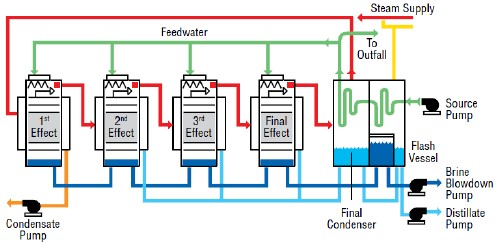
The system is based on a process called Multi-Stage Flash (MSF) desalination, which has been around for decades. But this new design introduces a loop configuration that simplifies the setup and dramatically reduces waste. Instead of relying on complex condenser piping, it uses reservoir tanks and passive soil cooling to condense water vapor—making it easier to build, maintain, and operate.
Key elements
- Minimal Liquid Discharge: Traditional desalination systems often produce large amounts of brine. This new system recycles nearly all of it, achieving up to 96% water recovery.
- Energy Smart: It’s optimized to use very little energy—just 0.63 kWh per litre of fresh water produced. That’s a big win for sustainability.
- Solar-Ready: Because it works well with low-grade heat sources, it’s perfect for pairing with solar energy in sunny regions.
The researchers tested the system’s feasibility in Chabahar, Iran, a coastal area with high solar radiation and limited access to fresh water. Local communities often rely on saline ponds, so a small-scale, low-cost desalination system could be life-changing.
The system operates in cycles:
- Heating: Salty water is heated until it flashes into steam.
- Condensation: The steam is cooled using underground soil, turning it into fresh water.
- Recovery: Brine and fresh water are stored in tanks, and the system resets for the next cycle.
It’s all controlled by smart valves and pumps, making the process efficient and automated.
This isn’t just a technical upgrade—it’s a shift toward accessible, sustainable water solutions. By reducing energy use and environmental impact, this system could help communities around the world gain reliable access to clean water without relying on large-scale infrastructure.
(Source: Nature)