


By John — Desalination News
A $260 million seawater desalination and irrigation complex in Morocco’s Dakhla region is in the final stage of construction, with its desalination plant now 97 percent complete and set to supply both farmland and drinking water along a stretch of Atlantic coast that has long been constrained by a fragile aquifer. Agriculture Minister Khalid Hatimy toured the site on 30 October, reporting that the project’s 60-megawatt wind farm, built to power the plant, is already finished, and that the 130-kilometer irrigation network delivering the water inland is 99 percent complete.
The project sits in the commune of Bir Anzarane, near Dakhla in Morocco’s southern provinces, a territory whose sovereignty remains disputed internationally as part of the broader Western Sahara conflict; Morocco administers the area and refers to it as part of its southern provinces. It was launched under Morocco’s New Development Model for the Southern Provinces, announced by King Mohammed VI to mark the 40th anniversary of the Green March. Once complete, the plant is designed to produce about 37 million cubic meters of desalinated water a year, roughly 100,000 cubic meters a day, split between 30 million cubic meters for irrigation and 7 million cubic meters for drinking water, the latter also earmarked to supply a planned Atlantic port in the region.
That split matters because it changes where the region’s farmland gets its water from. A regional agriculture director had previously said aquifer studies pointed to keeping irrigated land in the area to around 1,500 hectares to avoid depleting groundwater; drawing supply from the desalination plant instead removes that ceiling. The project is designed to open 5,000 hectares to irrigation, roughly three times the aquifer-constrained limit, with officials projecting about 500,000 metric tons of produce a year once the land is fully planted. Around 70 percent of that irrigated area is earmarked for horticulture, including tomatoes and onions destined for both the domestic market and export, building on Dakhla’s existing reputation for tomatoes, melons and blueberries.
Access to the newly irrigable land has been allocated in stages through a public-private partnership structure rather than all at once. A 2022 tender allotted 219 projects across 5,196 hectares, a further round in September 2024 added 79 projects over 1,778 hectares, and a June 2026 round allocated 35 projects across 1,090 hectares. The ministry has also set aside 100 smaller plots of five to ten hectares specifically for young people from the region, paired with technical support, an effort to spread the economic benefit beyond established agribusiness operators. Officials expect the project to support around 30,000 permanent jobs and generate more than 1 billion dirhams, over $100 million, in added value once fully operational.
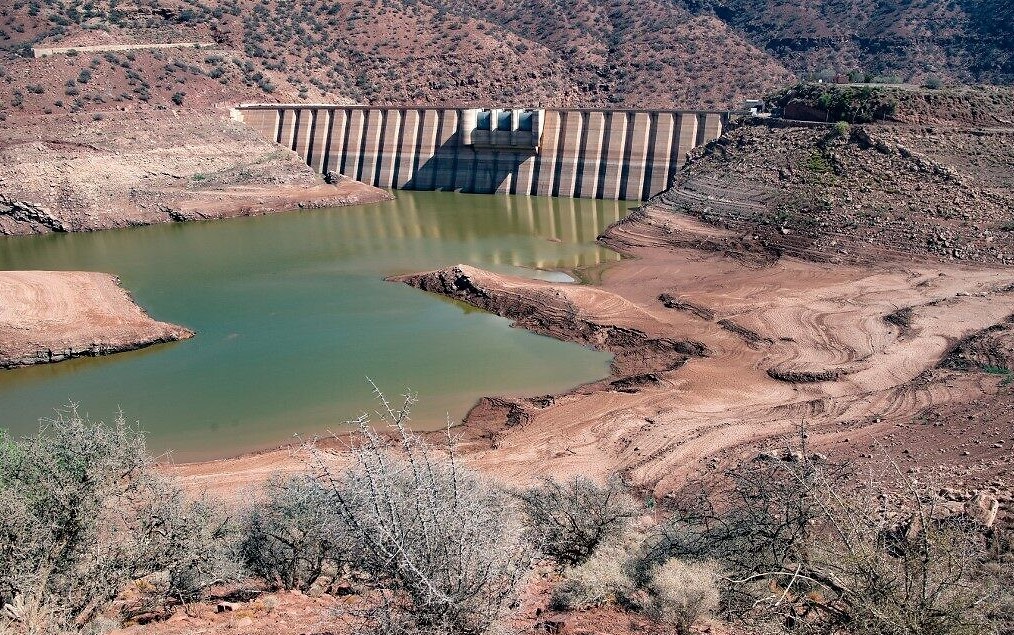
During his site visit, Hatimy also met with private investors who hold plots in the irrigated zone, part of the government’s continuing effort to line up operators ready to plant as soon as water deliveries begin. The Dakhla project is one piece of a larger national push: Morocco has said it is targeting 1.8 billion cubic meters of desalination capacity by 2031, spanning both drinking water and agricultural use, as the kingdom works to reduce its dependence on a dam and groundwater network strained by years of drought. The wind farm powering the Dakhla plant was flagged a year ago as part of French-backed investment in the southern provinces, when it was still under development alongside the desalination plant it now supplies.
With the wind farm finished and the plant and irrigation network both in their final stretch, the remaining work is incremental rather than structural. No commissioning date has been given for the desalination plant itself, but the near-complete status of all three components, power, water and conveyance, points to the project moving from construction into operation within the coming months, setting up Dakhla’s next planting cycle as the first real test of how much of that promised 5,000 hectares actually gets farmed.
(Source: Morocco World News)