


By John — Desalination News
Authorities on the Indonesian island of Batam are requiring data center operators to build their own seawater reverse osmosis (SWRO) desalination plants, after months of protests by residents whose piped water has been cut while nearby server farms kept running.
The clearest flashpoint came on October 5, when dozens of residents of Batam’s Nongsa district blocked access to Nongsa Digital Park, a cluster of data centers, saying their household taps had been dry for anywhere from three to six months. Police and military personnel were deployed to the site. A local official promised to restore piped water within two days and sent tanker trucks as a stopgap; by the following week, supply had been restored to only around half of the affected area, leaving residents frustrated and warning of further protests if the problem recurs.
Batam, an island of about 1.3 million people just across the strait from Singapore, has no natural freshwater sources of its own. The city relies entirely on rainwater collected in six man-made reservoirs — a system now under growing strain as a wave of data center investment arrives. Indonesia’s Coordinating Minister for Economic Affairs, Airlangga Hartarto, has pointed to roughly $4.5 billion in Nvidia-linked data center investment on the island, part of a broader build-out that officials say now tops $6.7 billion, much of it from Singapore-based developers. Around ten data center projects are planned in total; officials have said it is unclear exactly how much water existing facilities consume, since companies generally treat the figure as confidential. Local environmental groups have warned that at least one reservoir serving affected neighborhoods could run dry within a month without rain.
City and regional officials, including Batam Mayor and BP Batam head Amsakar Achmad, have responded by telling high-water-use industries, data centers chief among them, to meet their own needs from independent sources rather than draw down reservoirs meant for households. The preferred route is SWRO: developers are being encouraged, and in some cases required, to build their own seawater desalination capacity. Officials maintain the reservoir shortages are primarily the result of an extended dry spell rather than diversion to data centers, but the desalination push is explicitly framed as a way to take data centers’ water demand off the public system going forward.
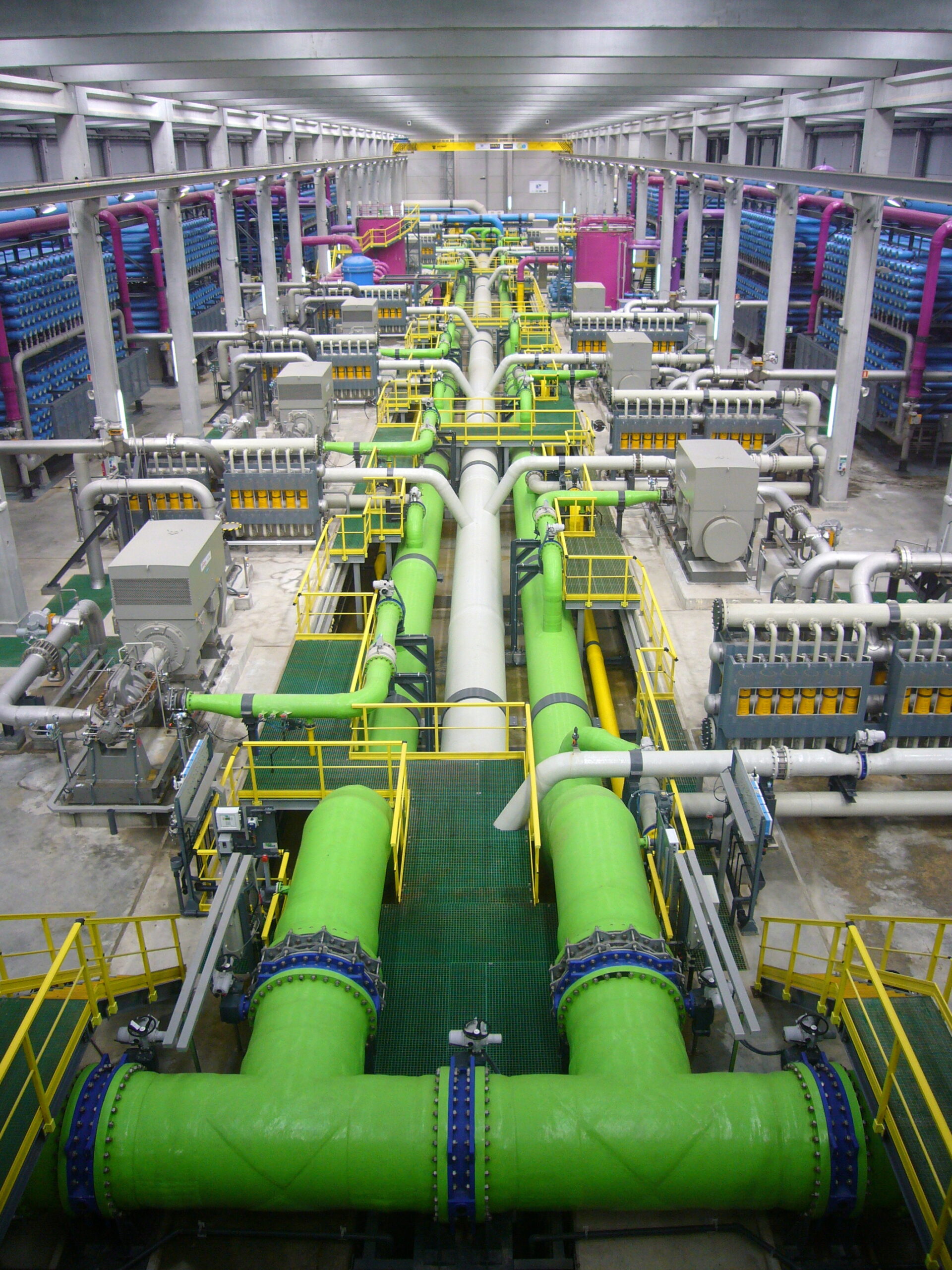
Two projects are furthest along. DayOne has agreed to build an SWRO plant at the Kabil Integrated Industrial Estate, an investment of roughly 180 billion rupiah (around $11 million), which will then be handed over to BP Batam to operate. Separately, PT Equator Gate System Batam is preparing an SWRO plant to supply a data center facility in the Teluk Mata Ikan area of the Nongsa Special Economic Zone. Combined, the two plants are expected to produce around 750 liters of desalinated water per second within two to three years, with a longer-term target of about 1,000 liters per second — roughly 86.4 million liters a day. Officials have floated the possibility that surplus output could eventually be routed to the public network, if capacity, water quality and distribution infrastructure allow it.
The episode is a vivid, community-level version of a dynamic already playing out at much larger scale in the Gulf, where AI data centers have pushed governments to accelerate desalination spending, and in recent academic work exploring desalinated or brackish water as a dedicated cooling source for data centers rather than competing directly with municipal supply. Batam’s situation differs in degree rather than kind: a small island with no freshwater of its own, absorbing a global AI infrastructure boom, is now being forced to build desalination capacity specifically to protect its residents’ taps.
Whether the mandate restores public trust will depend on execution speed. The first SWRO output is still two to three years away, while new data center projects continue to be approved; in the meantime, Batam’s reservoir-dependent households remain exposed to the same dry-spell risk that triggered October’s protests. Regional officials have cited Singapore, which plans to meet most of its future water needs through recycled NEWater and desalination by 2065, as a longer-term model for Batam’s own water strategy.
(Source: The Next Web, The Jakarta Post, Katadata)