


By John — Desalination News
A long-planned seawater desalination facility on Texas’ Harbor Island has cleared its last regulatory hurdle, after the Texas Commission on Environmental Quality (TCEQ) approved an offshore discharge permit for the project on September 23. The approval completes the permitting process for a plant that could eventually produce up to 100 million gallons of drinking water a day, making it one of the largest seawater desalination projects proposed in the United States.
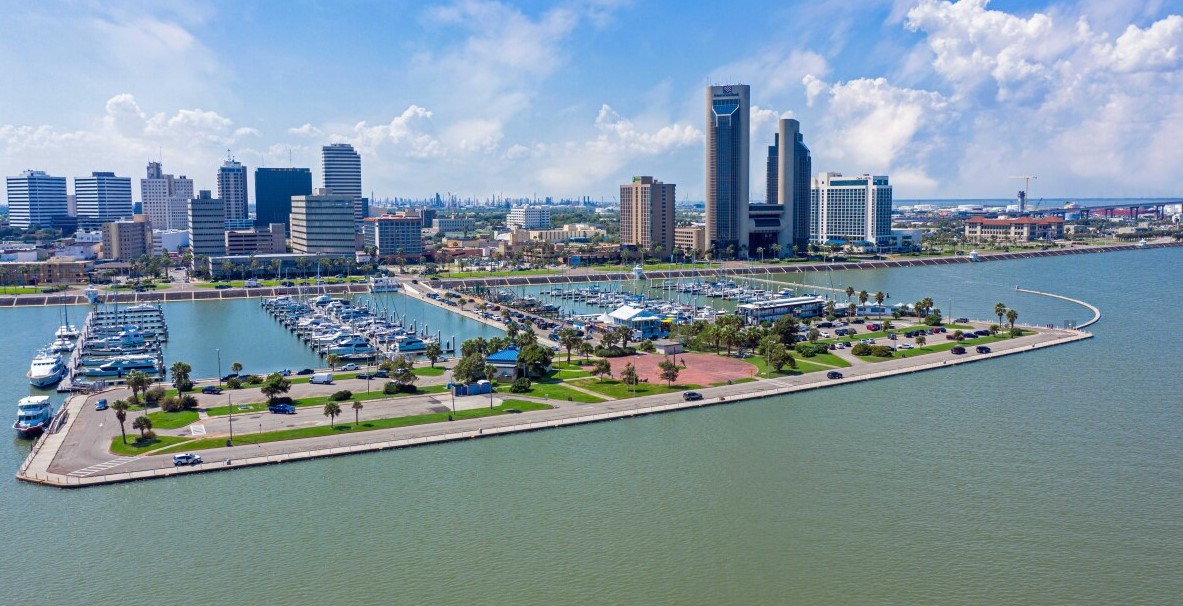
The facility is planned for Harbor Island, near Port Aransas on the Texas Gulf Coast, on land owned by the Port of Corpus Christi. The Nueces River Authority (NRA) holds the lease to develop the site, with Israeli desalination specialist IDE Technologies serving as the private partner responsible for building and operating the plant using reverse osmosis, a process that forces seawater through semi-permeable membranes to remove salt.
The TCEQ’s approval covers an offshore discharge permit for the brine byproduct of the desalination process. It replaces a smaller nearshore discharge permit the Port had secured back in 2022, after developers redesigned the project to move both the water intake and the discharge points further offshore. The change followed concerns from residents and environmental groups about the potential effects of concentrated brine discharge on Corpus Christi Bay’s marine ecosystem. The facility’s federal permitting, which covers the U.S. Army Corps of Engineers’ review of the project under the Clean Water Act and related statutes, had already been completed ahead of schedule under the Federal Permitting Improvement Steering Council’s FAST-41 program, which is designed to streamline reviews for major infrastructure projects.
Port of Corpus Christi CEO Kent Britton said the facility represents “a reliable, drought-resilient water supply for the region that would be significantly larger than otherwise contemplated,” underscoring the project’s role in a part of Texas that has faced recurring drought and rising industrial water demand tied to petrochemical and LNG facilities along the Coastal Bend.
The permitting process itself has taken nearly a decade from the Port’s initial pursuit of the project to this month’s final approval, reflecting the lengthy environmental review and community engagement typical of large coastal desalination developments in the U.S. In October 2025, the Corpus Christi City Council approved a $2.7 million payment to the Nueces River Authority to reserve 50 million gallons per day of the facility’s eventual 100-million-gallon daily capacity for city use, effectively pre-committing half the plant’s output before construction has even begun.
With permitting now complete, the project moves toward the construction and financing stage, though a specific construction timeline and total project cost have not yet been publicly detailed. The facility would draw on IDE Technologies’ track record operating large-scale seawater reverse osmosis plants worldwide, including major installations in Israel, California, and India.
The milestone comes as Texas communities increasingly turn to seawater and brackish groundwater desalination to diversify water supplies strained by population growth, industrial expansion, and drought. Other Gulf Coast desalination proposals in the Corpus Christi area, including a separate plant at the city’s Inner Harbor that was rejected by voters earlier this year, and a proposal to explore desalination at the Barney Davis Power Plant, illustrate both the appetite for new water supply and the political complexity surrounding where and how such plants get built along the Texas coast.
For now, Harbor Island stands as the furthest along of the region’s major proposed seawater plants, with full permitting now behind it and attention turning to whether the project can secure the financing and construction partners needed to turn a decade of planning into water flowing to Coastal Bend taps.
(Source: The Cool Down, BIC Magazine, KRIS TV)