


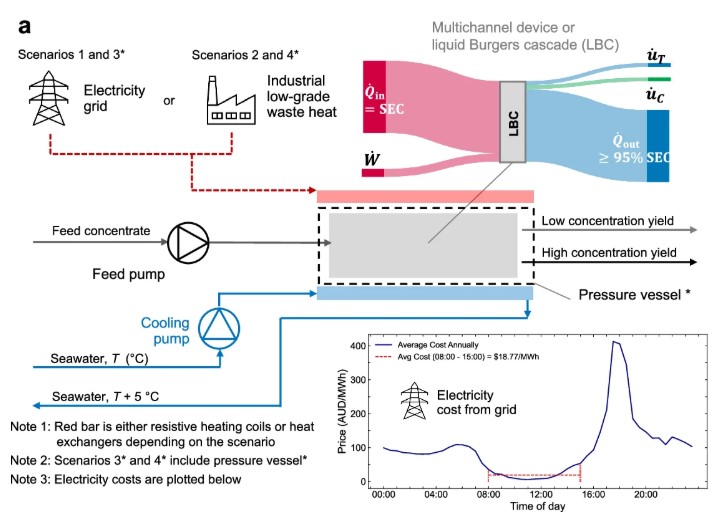
Freshwater scarcity and industrial brine pollution are interconnected global challenges. Conventional desalination technologies—such as reverse osmosis—struggle with hypersaline streams, while traditional thermal methods waste water through evaporation. To address these limitations, researchers have introduced Multichannel Thermodiffusion (MTD), a thermal process that enables desalination and brine concentration without phase change or specialized membranes.
This study evaluates the economic viability of MTD under realistic operating conditions, using both grid electricity and low-grade waste heat (LGWH) as energy sources. Performance was modeled across feed concentrations ranging from 10 ppt to 200 ppt, covering seawater and hypersaline brines. Results indicate that pressurized thermodiffusion powered by LGWH becomes more cost-effective than evaporation ponds for brine concentrations above ~95 ppt, offering faster processing and reduced environmental impact. However, current MTD desalination remains costly for full-scale freshwater production, though it shows promise as a pre-treatment step in hybrid systems.
A sensitivity analysis highlights heat cost and construction materials as key economic drivers. The study also explores MTD’s potential for treating industrial concentrates such as lithium brines, positioning the technology as a sustainable alternative for resource recovery and zero-liquid discharge strategies.
While further technological development is needed, MTD represents a scalable, energy-efficient approach to desalination and brine management, aligning with global efforts to secure water resources and minimize ecological harm.
(Source: Nature)