


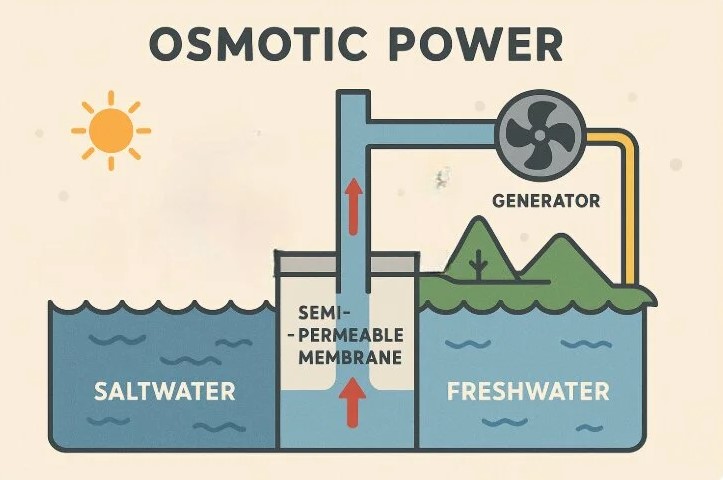
Each year, rivers deliver around 37,000 cubic kilometers of freshwater into the oceans, releasing energy equivalent to 2.6 terawatts—roughly matching global power consumption. At these mixing zones, the meeting of fresh and saltwater creates osmotic pressure of up to 26 bar, comparable to the force behind a 270-meter waterfall. Engineers have long asked: Can we turn this natural chemistry into electricity?
How Osmotic Power Works
Osmotic power systems, particularly Pressure Retarded Osmosis (PRO), harness energy from salinity gradients. Freshwater flows into pressurized seawater through a semipermeable membrane, expanding the volume and driving turbines to generate electricity. The membrane allows water molecules to pass but blocks salt ions, creating pressure that can be converted into power.
The Promise and the Problem
In theory, osmotic power could generate up to 5,000 terawatt-hours annually. But in practice, most systems operate at 1–3 watts per square meter (W/m²)—far below the 5 W/m² needed for economic viability. Membrane performance is the bottleneck: salt buildup and biofouling (from algae and bacteria) reduce efficiency and lifespan. Membranes also struggle under high pressure and require frequent replacement, making costs steep.
Hybrid Solutions: Desalination Meets Osmotic Power
A promising path forward is hybrid integration with reverse osmosis (RO) desalination plants. These facilities already handle high-pressure systems and produce brine waste, which enhances osmotic pressure. By adding PRO units to RO infrastructure, engineers can recover 0.5–1.0 kWh per cubic meter of desalinated water—cutting energy use by up to 30%.
Countries like Singapore and Japan are piloting these hybrid systems, using existing industrial setups to reduce capital costs and improve efficiency.
Building Better Membranes
To overcome technical limits, researchers are exploring biomimetic membranes inspired by aquaporins—natural water channels found in living cells. These membranes offer 10x higher permeability than conventional ones. Companies like Aquaporin A/S are scaling production, while others are experimenting with thin-film nanocomposites and PEG coatings to reduce fouling and improve flow.
Where Osmotic Power Fits
Osmotic power isn’t likely to replace solar or wind, but it offers a unique advantage: 24/7 clean energy, unaffected by weather or daylight. For coastal cities, island nations, and desalination hubs, it could become a reliable complement to other renewables.
As pilot projects in Norway, Denmark, Japan, and Singapore show, osmotic power is moving from concept to reality. The challenge now is making it cost-effective—and that depends on smart integration, better membranes, and strategic deployment where fresh and saltwater naturally meet.
(Source: Interesting Engineering)