


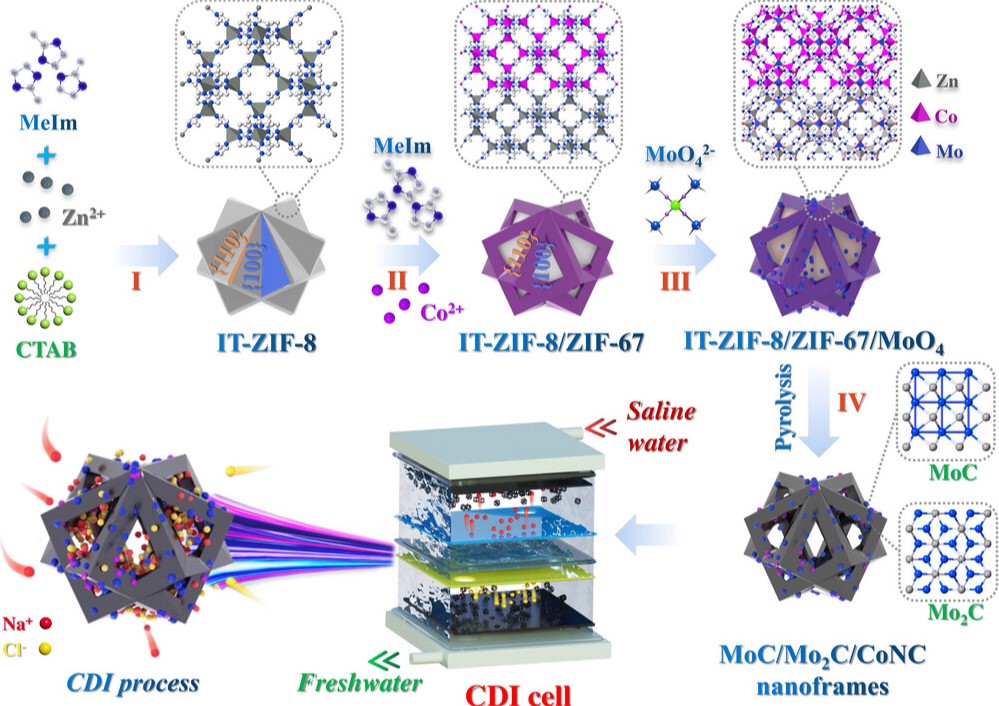
As global freshwater scarcity intensifies, capacitive deionization (CDI) has emerged as a promising low-energy desalination technology. However, its performance is largely constrained by the limitations of conventional carbon-based electrode materials. In response, researchers have developed a novel dual-phase molybdenum carbide (MoC/Mo₂C) electrode architecture embedded in metal–organic framework (MOF)-derived carbon nanoframes, offering a significant leap in CDI efficiency.
The Innovation: MOF-on-MOF Synthesis Strategy
The study introduces a multi-step synthesis process that begins with the creation of interpenetrated twin ZIF-8 (IT-ZIF-8) crystals. These serve as a scaffold for the facet-selective epitaxial growth of ZIF-67, forming a heterostructure. Through anion exchange, molybdate ions (MoO₄²⁻) are incorporated into the framework, followed by controlled pyrolysis. This thermal treatment converts the organic ligands into Co/N-doped conductive carbon nanoframes and simultaneously forms ultrafine MoC and Mo₂C nanocrystals.
Key Structural Features
- Dual-phase MoC/Mo₂C nanocrystals: Confined within the carbon matrix, these phases exhibit complementary electronic properties.
- Built-in electric fields: Formed at the heterointerfaces due to charge redistribution, enhancing electron mobility.
- High surface area and porosity: Inherited from the MOF precursors, enabling efficient ion transport and adsorption.
Performance Highlights
- High Salt Adsorption Capacity (SAC): Significantly outperforms traditional activated carbon electrodes.
- Low Energy Consumption: Efficient charge transfer reduces power requirements.
- Excellent Cycling Stability: Maintains performance over repeated desalination cycles.
- Dynamic Phase Transformation: Between MoC and Mo₂C during operation enhances Na⁺ adsorption/desorption kinetics.
Scientific Insights
Using in situ/ex situ characterization and density functional theory (DFT) calculations, the study reveals that the asymmetric charge distribution between MoC and Mo₂C creates internal electric fields that accelerate ion transport. This mechanism is central to the material’s superior desalination performance.
Broader Implications
This work not only introduces a new class of high-performance CDI electrodes but also demonstrates the power of phase-engineered heterostructures and MOF-derived nanomaterials in addressing global water challenges. The synthesis approach is scalable and environmentally friendly, making it a strong candidate for real-world desalination applications.
(Source: Advanced Functional Materials)